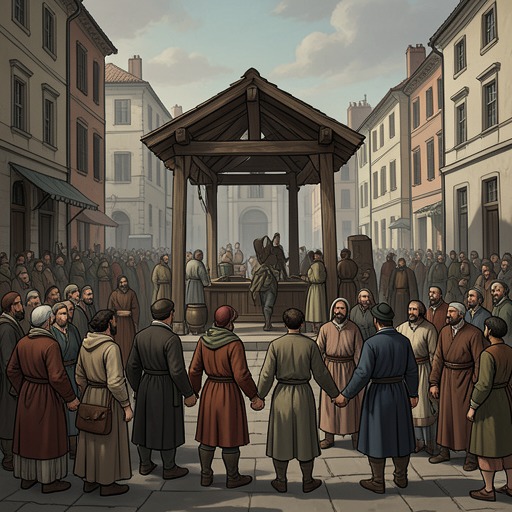
The people of England is free only during the election of members of Parliament
The Social ContractRousseau’s claim that the people of England is free only during the election of members of Parliament gives a pointed form to his rejection of representative sovereignty. A brief interval of electoral choice, he argues, cannot make a people sovereign when its deputies cannot speak or legislate in its place and the people do not personally ratify its laws.
The Claim and Its Setting
Rousseau introduces the expression while considering why popular sovereignty has been handed over to deputies. He identifies several pressures behind the practice: weakened patriotism, the rise of private interests, the great size of states, conquest, and abuses of government. Representation may appear a practical answer to those conditions, but it also rearranges political priorities: the interests of two orders come first, while the public interest is relegated to third place.
The English example makes the cost vivid. A people may regard itself as free because it chooses members of Parliament, yet Rousseau says that this freedom lasts only through the election. Once the members are chosen, the people cease to exercise the sovereignty that belongs to them. The formulation turns the electoral moment into a narrow opening rather than proof of continuing popular rule.
Why Sovereignty Cannot Be Represented
The reasoning rests on Rousseau’s distinction between sovereignty and its administration. Sovereignty lies in the general will, and a will cannot be represented: it is either the same will or another one, with no intermediate possibility. Deputies therefore cannot be the people’s representatives in the sovereign sense. They are stewards, and they cannot perform definitive acts on the people’s behalf.
This principle has a direct legal consequence. A law that the people has not ratified in person is, in Rousseau’s account, null and void—not a law at all. Election authorizes the selection of deputies, but it does not transfer the people’s legislative will to them. The expression about England condenses this distinction into a contrast between choosing lawmakers and remaining the author of law.
Freedom, Law, and Political Obligation
The claim belongs to a broader account of freedom founded on legitimate association rather than mere absence of restraint. Rousseau’s central problem is how an association can use its common force to defend each person and their goods while allowing each associate, in joining with all, to obey only himself and remain as free as before. The social compact is meant to reconcile common protection with self-government.
That reconciliation depends on the people remaining sovereign. Rousseau distinguishes natural liberty, bounded by an individual’s strength, from civil liberty, limited by the general will; he also distinguishes mere possession from property grounded in a positive title. In the civil state, obedience to a law prescribed to oneself can count as liberty. By contrast, political arrangements that replace the people’s will with an external will risk making citizens subjects of power they do not collectively control.
The compact’s enforcement does not cancel this distinction. Rousseau says that a citizen who refuses the general will may be compelled by the whole body, and calls this being forced to be free: the common rule is supposed to secure citizens against personal dependence. That argument presumes a law expressing the general will, not a deputy’s unratified decision. The English expression thus warns that formal participation at election time cannot by itself establish freedom throughout political life.
Representation and the Loss of Popular Rule
Rousseau calls representation a modern idea, tracing it to feudal government, which he condemns as degrading humanity. He contrasts it with ancient republics and monarchies, where the people had no representatives in the modern sense. In Rome, even tribunes did not claim the people’s legislative functions or pass a plebiscite on their own authority. The example of citizens voting from rooftops in the time of the Gracchi illustrates the practical difficulty of assembling a large population, but does not, for Rousseau, justify transferring sovereignty to deputies.
The expression’s force is therefore both institutional and diagnostic. It identifies a recurring gap between a people’s belief that it governs itself and its actual ability to make binding law. In Rousseau’s account, the decisive test is not whether citizens periodically choose representatives, but whether public authority remains answerable to a will the people themselves have formed and ratified.